
Wynn Resorts Chief Executive Craig Billings had a packed agenda of subjects to cover during the firm’s Q1 earnings conference on Thursday – positive and negative – as the corporation reported robust performance across Las Vegas and Macau.
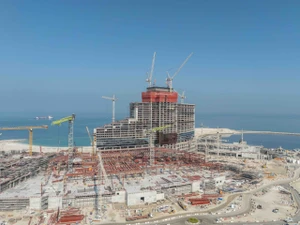
The foremost question on everybody’s thoughts was unrelated to earnings and entirely about the Middle East. The US-Israeli conflict with Iran that began on 28 February and reached a truce on 8 April has affected the timeline of the highly anticipated Wynn Al Marjan integrated resort in the UAE.
In his initial remarks since the hostilities started, Billings verified that Wynn anticipates a “slight postponement” in the launch of the $5.1 billion integrated resort, but refrained from providing further specifics. The gaming venue was initially scheduled to debut in March 2027, but Billings referenced 2027 broadly in his comments. While he recognized elements beyond the firm’s influence, he praised the UAE’s security measures and minimized enduring threats to the venture.
“I noted that we anticipate a slight delay, and I employ the term slight deliberately, as that is our conviction,” Billings informed analysts. “We prefer not to gauge it until we possess a genuine perspective on stability.”
Wynn’s first-quarter consolidated revenue reached $1.86 billion, a 9% increase compared to the prior year, while net profit nearly doubled from $72 million to $120.5 million this year. Wynn’s adjusted property EBITDAR totaled $562.4 million, reflecting a moderate 5% rise over last year. In the recent quarter, Wynn allocated $100 million to Al Marjan, raising its cumulative investments to $1 billion.
Enduring consequences for the UAE?
The immediate repercussions of the Iran conflict, including elevated energy costs and diminished international travel, might evolve into sustained uncertainties regarding the commercial potential of the area as the dispute stays unsettled. Billings reassured analysts that daily life in the emirates proceeds as normally as feasible, though there have been persistent effects.
The UAE announced on 28 April it is exiting the Organization of the Petroleum Exporting Countries (OPEC), a notable event for a six-decade-old alliance that wields considerable sway over energy markets. As demonstrated by the Wynn venture and the expansion of Dubai and Abu Dhabi as transit centers, the emirates’ economy has become sufficiently varied that such a departure seems justified.
“This choice concerns far beyond output caps or conflict-related interruptions. It mirrors structural transformations in worldwide energy markets, essential changes in the global economy, and a lucid perspective on the UAE’s current position – and its trajectory,” Yousef Al Otaiba, the UAE’s envoy to the US, penned in the Financial Times.
The actuality of the Iran conflict and its far-reaching effects, nevertheless, has presented grounds for worry. Emirati authorities have reached out to the US regarding a possible currency swap arrangement, and its defensive systems are contending with Iranian assaults during a delicate truce. As of early March, the US State Department categorized the UAE under a Level 3 travel alert, meaning that Americans ought to “reconsider travel” because of conflict hazards. Nonetheless, Billings stated on Thursday that Wynn initiated Al Marjan recognizing a certain degree of unpredictability.
“When we backed this venture, we didn’t back a region devoid of geopolitical uncertainty – we backed a nation with a proven capability to navigate through it and appear in an improved competitive standing on the opposite side,” Billings remarked.
The Enclave arriving at Cotai
After finishing the UAE briefing, Billings and his team proceeded to a far more upbeat disclosure, a fresh all-suite hotel tower at Wynn Palace in Cotai dubbed The Enclave.
Priced at an approximate $900-$950 million, the 432-suite structure will increase the property’s room inventory by 25% and its suite inventory by 50%. Building work will commence at some point in 2026 and is scheduled to last roughly two and a half years. The tower will lack a gambling element and feature minimal facilities, yet is still projected to generate substantial worth in the marketplace.
“When you achieve 99% occupancy, you aren’t placing a risky wager by adding rooms; you are plainly seizing demand that already exists and that you are now rejecting,” Billings stated. He further noted that it is “fair to presume” the tower could yield $400 million in extra gaming revenue.
Wynn’s Macau division recorded total adjusted EBITDAR of $279.5 million, a 10% rise annually, and operating profit surged 14% to $145.2 million. Wynn Palace in particular enjoyed an exceptional quarter, with its gaming income and adjusted EBITDAR each increasing by over 25% YoY.
Wynn sustains Las Vegas momentum
Unlike its counterparts MGM and Caesars, analysts showed minimal worry on Thursday regarding Wynn’s results in Las Vegas, which has remained more stable than its rivals for multiple quarters because of the firm’s focus on affluent customers. Following a challenging 2025, the overall market is progressing well in 2026 thus far, with visitor numbers and gambling income both moving upward.
Wynn’s Las Vegas income expanded 6% annually to $661.9 million in the first quarter, with adjusted EBITDAR rising 4% to $232.5 million. RevPAR, or revenue per accessible room, reached $506 for the period, a 10% rise, and its average daily rate of $592 represented a 12% increase compared to last year.
In certain respects, Wynn is the contrary of most Las Vegas operators as it deals with difficult year-over-year comparisons owing to its superior performance. The firm is also commencing a refurbishment of its Encore tower this year, which will cause some degree of disturbance, but its general forecast stays optimistic.
“Las Vegas is performing remarkably well by any historical measure … everything we observe looking ahead through the year, and based on what we witnessed in Q1, gives me confidence about 2026,” Billings commented. “However, I wish to clearly differentiate us from the overall market, because we didn’t experience a deceleration in 2025.”
No inquiries were made this quarter regarding Wynn’s unused 38-acre parcel on the Strip, which has long been a topic of conjecture. The corporation has stayed mostly impartial about the fate of the land, acquired for $336 million in 2017.
Stock fluctuating as Fertitta disposes of call options
Wynn concluded Q1 with total cash and equivalents of $1.19 billion, not counting $607.6 million in short-term investments held by Wynn Macau. The firm also ended the quarter with aggregate debt of $10.5 billion, comprising $5.76 billion of Macau-associated debt and $877.2 million of debt from Wynn Las Vegas. The organization bought back $53.8 million worth of stock during the period and retains $401 million in buyback authorization.
On that matter, Wynn’s largest stakeholder Tilman Fertitta is engaged in acquisition discussions with Caesars, and has been consistently divesting call options on his holdings over recent months. Wynn earlier informed iGB that it does not remark on its shareholders, and no queries were raised on Thursday.
Wynn shares fell approximately 4% in trading on Friday to $102, amid a somewhat turbulent period for investors. The stock has declined over 20% in the past six months but risen 17% over the past year. Macquarie analyst Chad Beynon assigned Wynn an “outperform” rating on Friday while also reducing the price target to $150, from $152.
“While UAE scheduling ambiguity continues as the main short-term discussion, we think the market is undervaluing the resilience of Vegas and Macau profits, and we persist in attributing $25–$50 per share of enduring equity value to Wynn Al Marjan Island,” Beynon wrote.
“Additionally, we consider WYNN stock is trading more similarly to wider consumer discretionary stocks, in spite of multiple structural advantages: (1) mid-single-digit-plus Macau expansion propelled by premium mass; (2) ongoing Las Vegas outperformance backed by luxury pricing influence; (3) a substantial long-term boost from Al Marjan; and (4) a capital-efficient deployment approach bolstered by robust liquidity.”
Polymarket, a prominent forecasting platform, featured over twelve event contracts regarding the Iran conflict on Friday evening. As of 5 p.m. ET, one contract assigned a 74% likelihood of a lasting peace agreement between the US and Iran by 31 December.